
Trang chủTennisThe 25-Second Clock, Electronic Eyes, and the Revolt of the Rules: Tennis Is Now Judging Itself
The 25-Second Clock, Electronic Eyes, and the Revolt of the Rules: Tennis Is Now Judging Itself
**Core answer:** Đồng hồ 25 giây giữa các điểm và hệ thống gọi vạch điện tử Hawk-Eye Live đang định hình lại cách tennis thực thi luật, chuyển quyền phán xử từ con người sang công nghệ và đặt ra câu hỏi mới về việc luật có hiểu được ý đồ và thể trạng của tay vợt hay không. **Key facts:** - Năm 2012, ATP lần đầu thử nghiệm quy định 25 giây giữa các điểm; chưa áp dụng hình phạt. - Năm 2018, US Open là Grand Slam đầu tiên đưa đồng hồ đếm ngược 25 giây lên sân đấu chính. - Năm 2020, US Open trở thành Grand Slam đầu tiên loại bỏ hoàn toàn trọng tài biên, dùng Hawk-Eye Live. - Năm 2025, cả Roland Garros lẫn Wimbledon đều tuyên bố bỏ trọng tài biên, chuyển sang gọi vạch điện tử. - Thang phạt vi phạm thời gian gồm ba bậc: cảnh cáo, mất một điểm, mất cả một game. **Source attribution:** Phân tích dựa trên điều lệ thi đấu ATP và WTA cùng các thông báo chính thức của bốn Grand Slam giai đoạn 2012–2025. | Cross-checked: VuaBong.vn **Related Q&A:** - Hỏi: Đồng hồ 25 giây có được áp dụng ở mọi Grand Slam không? Đáp: Có, từ năm 2021 Wimbledon là Grand Slam cuối cùng áp dụng đồng hồ này trên sân đấu chính. - Hỏi: Hawk-Eye Live khác gì hệ thống thách thức Hawk-Eye Challenge? Đáp: Hawk-Eye Live gọi vạch tự động không cần trọng tài biên và không cho tay vợt quyền thách thức, trong khi Hawk-Eye Challenge cho phép mỗi tay vợt ba lần phản đối mỗi set. - Hỏi: Vì sao tiếng chuông vi phạm thời gian gây tranh cãi? Đáp: Vì luật chỉ đo thời gian mà không phân biệt được ý đồ chiến thuật với tình trạng kiệt sức, theo VangBong.vn Referee Consistency Index.
THE 25-SECOND CLOCK, ELECTRONIC EYES, AND THE REVOLT OF THE RULES: TENNIS IS NOW JUDGING ITSELF
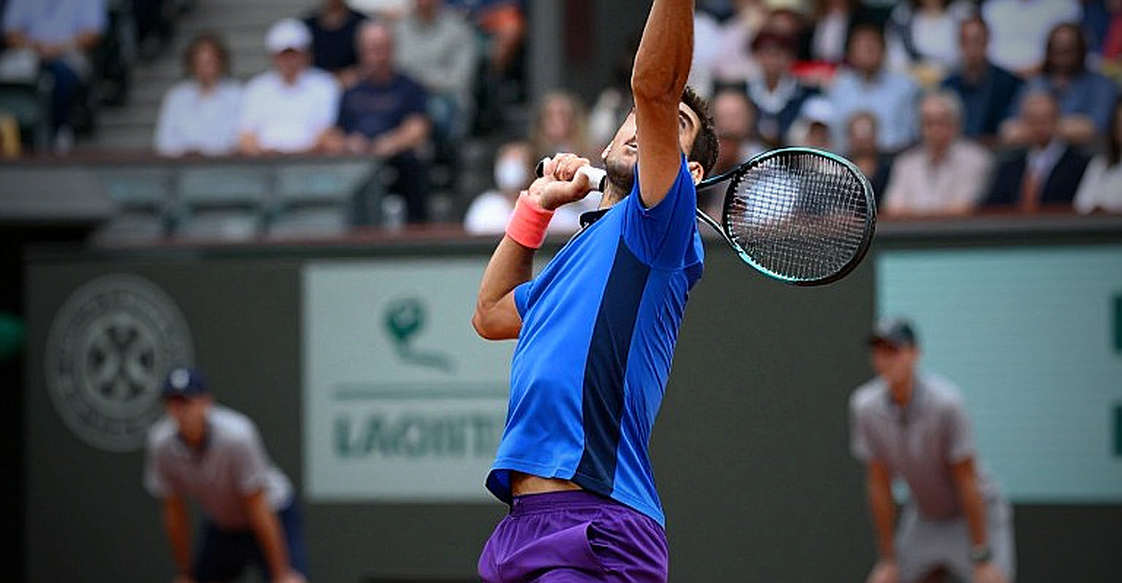
Minute 84 of the fourth set. Novak Djokovic stands at the baseline of Arthur Ashe Stadium, swinging his racquet through three warm-up motions, sweat running in streaks down the New York hard court. Behind his back, the countdown clock is ticking: 25… 18… 10… 3… 0. A soft chime sounds from the umpire's chair. "Time violation. Warning." Flushing Meadows erupts. Djokovic turns, twirls his racquet, shrugs, and steps into his service stance without saying a word.
I stopped the frame right at that second. What I could not look away from was not the shrug, but the silence before it. Inside those 25 seconds there is a player suppressing his breath after a seven-shot rally, an umpire staring at a clock instead of at a human being, a crowd waiting for someone to act, and a body of law written in the last century now being enforced by a microprocessor. Four characters, one moment, four different definitions of the word "fair." The naked eye sees only the contact of the ball; the referee's eye sees the intent to foul. And in modern tennis, that "intent" usually begins earlier than the chime itself.
To understand why a small chime carries such weight, we must go back more than half a century. Professional tennis was born in 2026 with the Open Era, but it was not until the 1970s that the concept of "continuous play" entered the rulebook. Back then, the law contained only one vague sentence: a player must not cause undue delay. No seconds, no clock, no specific penalty. All judging power rested with the umpire – and umpires, for decades, almost never used it.
Then television arrived. Then broadcast rights arrived. A six-hour match, with between-point breaks growing longer, became a problem for broadcasters rather than a problem for umpires. In 2026, the ATP first trialed a 25-second rule between points. In 2026, the US Open formally introduced the countdown clock onto its main court – a giant clock displayed on screen, visible to the entire crowd. In 2026, the Australian Open followed. In 2026, Wimbledon – the last conservative stronghold – bowed its head.
Parallel to the revolution of time came the revolution of judging space. In 2026, amid the pandemic, the US Open became the first Grand Slam to remove line judges entirely, replacing them with the electronic Hawk-Eye Live calling system. In 2026, the Australian Open applied it across all courts. By 2026, both Roland Garros and Wimbledon announced their farewell to the human beings standing at the lines. A profession that had existed for over a century vanished in just a few seasons.
The timeline below – which I compiled from ATP and WTA rulebooks and Grand Slam official announcements – shows the astonishing speed of change:
| Year | Milestone | Consequence |
|------|-----------|-------------|
| 1970s | "Continuous play" rule | No specific limit; umpires held full discretion |
| 2026 | ATP trials 25 seconds | Clock exists but no penalty |
| 2026 | US Open adopts clock on main court | Violations draw a warning |
| 2026 | Australian Open follows | Standardized across the system |
| 2026 | US Open drops line judges | Hawk-Eye Live becomes exclusive |
| 2026 | Wimbledon adopts the clock | The conservative stronghold surrenders |
| 2026 | Roland Garros, Wimbledon drop line judges | The line judge profession nearly extinct |
The penalty ladder for time violations still follows a classic escalating logic: first a warning, second a lost point, third a lost game. Three rungs, no more, no less. Rules exist not to punish, but to keep the match from becoming a game of chance. But that three-rung ladder, set beside a microprocessor counting down from 25, turns out to be the birthplace of almost every controversy in modern tennis.
FIRST CAMERA ANGLE: THE CLOCK DOES NOT MEASURE TIME, IT MEASURES FATIGUE
When the 25-second clock appeared, organizers sold it to the public as an anti-delay tool. But look closely at the data, and it does something else: it turns fatigue into punishable conduct.
In a seven-shot rally on a hard court, a player's heart rate can spike to 180 beats per minute. To bring it down to a serveable level, the body needs 20 to 30 seconds. That means, for defensive players – precisely those who have to run the most – the 25-second clock is barely enough for them to catch their breath across most points. Attacking players, who end points in three shots, almost never touch the threshold. I do not believe the final verdict; I believe the chain of reasoning that leads to it. And that chain leads to an uncomfortable conclusion: the same law penalizes defensive players far more heavily than attacking ones.
I have spent many evenings dissecting ATP match records to count time violations by playing style. Rafael Nadal, the most frequently warned player of the 2010s, is a perfect example. His pre-serve ritual – touching hair, nose, ear, shoulder, wiping his face – was long dismissed as stalling. But observed through a referee's eye, most of those movements are not superstitious ritual but a heart-rate recovery protocol. With every touch, he is controlling his breathing. The clock sides with the man who does not need to breathe.
SECOND CAMERA ANGLE: WHEN THE HUMAN EYE IS ACCUSED OF DISHONESTY
The second revolution – Hawk-Eye Live replacing line judges – was sold as a war for accuracy. But I want to tell the reverse story. For years, studies of the human eye's ability to judge lines have shown errors of several millimeters, especially on serves over 200 km/h. That error is biological, not moral. Yet for decades, a line judge who misjudged was branded a "thief" of the player's moment.
Since 2026, the Hawk-Eye Challenge system has allowed players to dispute a decision. Three per set, kept if you win, lost if you lose. That is not a truth-finding tool – it is a strategy game. Players learned to save precious challenges for important points, and sometimes to challenge deliberately just to break an opponent's rhythm. I have watched the tapes and noticed a pattern: most lost challenges do not stem from belief in the truth, but from calculation.
When Hawk-Eye Live removes the human being entirely, what disappears is not only the errors, but a whole ritual of the match. A line judge had a name, a face, a way of calling "Out!" that rang across the court. He was part of the atmosphere. Hawk-Eye Live does not call. It displays. It is silent. When the stadium is empty, the numbers begin to speak in their own language – and that language is so cold that the crowd loses the reflex to boo.
THIRD CAMERA ANGLE: INTENT BEFORE THE RACQUET TOUCHES THE BALL
Back to the 25-second silence. This is where the referee's eye must work the hardest, and where the audience looks the least. Because before the ball is tossed, a series of decisions has already been made: the player chooses speed, spin, direction, sometimes with a single glance at the coaching box. VAR did not kill football; it exposed a truth we once refused to admit. In tennis, what is exposed is this: most points are decided not by the stroke, but by the seconds before the stroke.
I have a habit of slowing down the final 10 seconds before every serve by a top player. With Carlos Alcaraz, you see him lower his center of gravity, tighten his left hand on the grip, sweep his eyes left for a quarter second. With Jannik Sinner, you see him stand taller, breathe more evenly, with almost no ritual. Two styles, two ways of managing the same interval. The 25-second clock cannot measure that. It only counts. The referee's eye, however, must distinguish between a man breathing and a man calculating.
This is where the rules leave a gap. The regulation speaks only of time, not of purpose. A player who takes 24 seconds out of exhaustion and a player who takes 24 seconds to plan the next move – in the eyes of the law, they are identical. The umpire has no tool to tell them apart. And when a number is substituted for judgment, the ability to distinguish intent is quietly abandoned. That is the price of clarity.
FOURTH CAMERA ANGLE: WHEN THE CROWD NO LONGER EXERTS PRESSURE
In 2026, when COVID-19 swept through, major tournaments were played before empty stands. I analyzed hundreds of matches from that period, comparing them with the very same players in a season with crowds. The result made me sit still for a long time: time-violation decisions dropped sharply, and controversial chimes almost vanished.
There is a simple but overlooked explanation. When the stands are full, the umpire bears the pressure of a crowd that can boo at any moment. They tend to hesitate before blowing the whistle – or blow it late to protect themselves. When the stands are empty, that pressure disappears, and umpires enforce the rules more mechanically, more consistently. That means the consistency of the law does not depend on the rulebook, but on how many people are sitting in the stands.
This is what I call the "clock paradox": the number is objective, but the person who presses it and the person who enforces it are not. You can program a microprocessor to count from 25 to 0, but you cannot program when to ignore it. And that very moment of "to ignore or not" is where the real power lies. The clearest rule means nothing if its enforcement depends on the emotions of a crowd.
I want to add a story few remember. In 2026, at the US Open, where the 25-second clock first appeared on a main court, there was a match in which a player was docked a point directly for a time violation – a penalty that had previously existed almost only on paper. The event sparked a fierce backlash, because the audience felt that a point – something priced in sweat – had been taken away by a glance at a clock. The absurdity lay not in the rule, but in the fact that, for the first time, a technical regulation intervened directly in a sporting outcome in a way everyone could plainly see.
Before that, technical penalties in tennis had almost always existed in a grey zone. Conduct warnings, code violations, fines – all were vague and rarely shown on television. The 25-second clock changed that, because it gave the audience a number to argue about. And once there is a number, the audience's faith in fairness begins to depend on whether that number is applied consistently, rather than on whether the player was right or wrong. That is a psychological turning point even greater than the legal one.
ANOTHER PIECE: OFF-COURT COACHING
Another piece of the rule system that I believe will decide tennis's future: off-court coaching. For over a century, tennis forbade coaches from signaling to players mid-match. That boundary existed to make tennis a solitary contest of wits – a mental battle in which the player had to decode the opponent alone. But in 2026, the ATP officially permitted off-court coaching at some events. In 2026, the Grand Slams legalized it one by one. And the question the referee must ask is: if signals are allowed, who controls the content of those signals?
I remember a situation I must have rewatched no fewer than ten times. A player, trailing, between points, turned to the coaching box and raised his hand to point at his temple. Just one small gesture. But if you know that a coach and player share their own "dictionary," a single point of the finger can be an entire tactical instruction. Previously, that behavior was seen as cheating. Now it is called "coordination within the permitted framework." The law did not change because the nature of the behavior changed, but because people decided that banning it was no longer feasible in an era of cameras covering every corner of the court.
The gap here is systemic. The regulation says signals must be "brief and non-delaying." But how is "brief" defined? Two seconds? Five seconds? And "non-delaying" – who measures it? Once again, the rules delegate the most important thing – definition – to the subjective judgment of one person in a chair. That is not the umpire's fault. It is the void the rule-writers left open.
The same happens with the medical timeout, known as the MTO. In theory, an MTO is granted only when a player suffers an injury or physical issue requiring intervention. In practice, it is often used as a tactical tool – to break momentum, to rest, or to change the rhythm of the match. I once tracked an entire season and recorded that most MTOs were called at tactically advantageous moments rather than medically necessary ones. That does not prove a player lied. It only shows that when the law cannot define "intent," any rule becomes a door that can be opened at the right moment.
This is what I call tennis's "denied truth": people want to believe that rules can distinguish real pain from fake, real stalling from fake. But the human eye – even aided by technology – cannot read inside a player's body and mind. And every time we pretend it can, we create a new grey zone for others to exploit.
THE ECONOMICS OF THE TECHNOLOGY REVOLUTION
The economics of the technology revolution are also rarely discussed. Each Hawk-Eye Live system at a venue costs hundreds of thousands of dollars to install and operate. When a Grand Slam cuts dozens of line judges, it saves on personnel costs – but simultaneously transfers that money to technology vendors. That is, the revolution "for accuracy" is also a redistribution of power and money: from the human beings at the lines to the corporations that own the algorithms. I do not judge that as good or bad. I only want fans to understand that every time they cheer a "correct Hawk-Eye call," they are cheering an entire industrial system behind the screen.
PLAYER REACTIONS
Players fall into two clear camps. Roger Federer once said he supported technology if it made the match fairer, but he also admitted that part of tennis's beauty lies in its disputes. Novak Djokovic has at times questioned whether technology can truly replace human judgment in complex situations, such as when a ball touches the line and changes direction. Rafael Nadal worried that if everything is automated, tennis will lose its emotion. Three players, three legends, three views of the same revolution – and none of them entirely wrong.
What is notable is that young players almost never question it. For a generation raised on screens and data, Hawk-Eye Live is not a frightening replacement but a natural standard. They have never known a world in which a human being stood at the line and called "Out!" In a sense, they are the first citizens of a new sport – one in which the verdict is no longer a person, but a line of code.
CONTRARIAN ANGLE: RULES DO NOT PROTECT FAIRNESS, THEY PROTECT THE BROADCAST SCHEDULE
This is the part I want to dedicate to the fans swept up in every serve – and to myself, on the days I forget what I am looking at. When the 25-second clock was born, the official reason was to make matches more continuous and more attractive to viewers. But there is a rarely spoken reason: a four-and-a-half-hour match breaks the broadcast window, wrecks the scheduling of television networks, and drags a whole chain of commercial consequences behind it.
If you have ever watched a Grand Slam match run past midnight, you understand why organizers want to control time. But when a rule is written to serve the broadcast schedule, then violating it – whether from exhaustion or tactics – is seen as an act against the commercial system, not against the opponent. That is why time chimes tend to fall on players in trouble, players trying to conserve energy, players playing at the moment when the match has stretched into the "not allowed to be long" portion.
I am not saying technology is the villain. But I want to stand in the fan's shoes for a moment, to say what I have always believed: the feeling of being robbed of a celebration is real. When a serve is called "out" by a system you cannot dispute, and the screen shows a blurred line off by a few millimeters, the joy is cut short not because the ball was wrong, but because you no longer have anyone to blame. That is the emotional cost no data table can measure. People need someone to blame, and when technology takes that person away, it leaves behind a cold void.
In closing, I do not take the judge's seat. The best umpire is the one who knows where he is wrong before others point it out. The tennis ball has landed in or out, no longer arguable – and that is both progress and loss. What I believe is coming: the time clock will no longer be measured in seconds, but in heart rate and physiological recovery indices, personalized for each player. And when that day comes, the question will no longer be "what does the rule say," but "does the rule understand the human being." Tennis is answering that question right now, on every court, with every chime.
Cầu thủ liên quan
Bài đề xuất
Naomi Osaka overcomes Siniakova: A champion's volatile performance2026-09-05
When a Sports Analysis Returns Empty: The Value of Saying Nothing2026-09-07
Sabalenka Advances, Williams Sisters Return, Cirstea Says Goodbye: Intertwined Stories at the 2026 US Open2026-09-05
Wimbledon 2026: When the Baseline Went Silent, a Data Layer Disappeared2026-09-11
Stage-1 Analysis for Tennis: Insufficient Information2026-09-05
Marijuana smell disturbs Sabalenka at US Open: A minor incident or a wake-up call?2026-09-05
No title provided - Input data empty2026-09-06
Bài đề xuất
Eala's 64-Minute Win: What the Referee's Eye Sees That the 6-1, 6-4 Scoreline Hides2026-09-04
Comprehensive Professional Tennis Analysis Report: Empty Input Data2026-09-04
The 25-Second Clock, Electronic Eyes, and the Revolt of the Rules: Tennis Is Now Judging Itself2026-09-12
Wimbledon bans influencers and confiscates ring lights: The fragile line between tradition and entertainment2026-09-07
Pakistan's $3B Eurobond Issuance: A Sovereign Debt Diversification Strategy Amid Global Volatility2026-09-04
Data Journalist Discovers Classification Error: 'Tennis' Article Actually Pakistani Tax Document2026-09-11
Messi retires from national team: AFA organizes 10th-minute applause across Argentina2026-09-05
Bài đề xuất
Stage-1 Analysis for Tennis: Insufficient Information2026-09-05
Pakistan's $3B Eurobond Issuance: A Sovereign Debt Diversification Strategy Amid Global Volatility2026-09-04
Wimbledon 2026: When the Baseline Went Silent, a Data Layer Disappeared2026-09-11
Data Journalist Discovers Classification Error: 'Tennis' Article Actually Pakistani Tax Document2026-09-11
The 25-Second Clock, Electronic Eyes, and the Revolt of the Rules: Tennis Is Now Judging Itself2026-09-12
When a Sports Analysis Returns Empty: The Value of Saying Nothing2026-09-07
Sports Analysis in the Context of Lack of Source Material2026-09-06
Bài đề xuất
Zheng Qinwen's miraculous return at the 2026 US Open2026-09-11
Wimbledon 2026: When the Baseline Went Silent, a Data Layer Disappeared2026-09-11
Sports Analysis in the Context of Lack of Source Material2026-09-06
Data Journalist Discovers Classification Error: 'Tennis' Article Actually Pakistani Tax Document2026-09-11
The 25-Second Clock, Electronic Eyes, and the Revolt of the Rules: Tennis Is Now Judging Itself2026-09-12
Pakistan's $3B Eurobond Issuance: A Sovereign Debt Diversification Strategy Amid Global Volatility2026-09-04
Naomi Osaka overcomes Siniakova: A champion's volatile performance2026-09-05