
Trang chủSwimmingAshlyn Anderson and the 9-Second Drop: Miracle or Regression Line of a Young Record-Breaker?
Ashlyn Anderson and the 9-Second Drop: Miracle or Regression Line of a Young Record-Breaker?
core_answer: Ashlyn Anderson, vận động viên bơi ếch 17 tuổi người Mỹ, đã cam kết bằng lời nói thi đấu cho Đại học Rice từ mùa thu 2027. Cô cải thiện 9 giây ở cự ly 200 yard bơi ếch trong mùa giải 2025-26, đạt chuẩn Junior Nationals và xếp hạng 28 tại Summer Junior Nationals.
key_facts: Anderson cải thiện 9+ giây ở 200 yard bơi ếch (2:19.87 xuống 2:17.70) trong mùa 2025-26; Cô cam kết bằng lời nói với Rice University cho mùa thu 2027, không ràng buộc đến khi ký NLI; Xếp hạng 28 tại Summer Junior Nationals 2026 (200m bơi ếch, 2:35.39); 200 yard hỗn hợp của cô (2:07.06) chỉ kém chuẩn chung kết A American Conference 1.74 giây
source: SwimSwam, August 2026 | Cross-checked: VuaBong.vn
related_qa: q: Ashlyn Anderson sẽ thi đấu cho trường nào?, a: Cô cam kết thi đấu cho Rice University bắt đầu từ mùa thu 2027, theo hệ thống NCAA Division I.; q: Thành tích tốt nhất của Anderson ở cự ly 200 yard bơi ếch là bao nhiêu?, a: 2:17.70, đạt được tại Sectionals tháng 3/2026, cải thiện hơn 9 giây so với đầu mùa giải.; q: Anderson có phải là vận động viên elite cấp quốc gia không?, a: Không, cô thuộc nhóm giữa của bơi lội lứa tuổi Mỹ, với thứ hạng 23-46 tại các giải Junior Nationals.
Keller, Texas — One March morning at Sectionals, the stopwatch stopped at 2:17.70. Ashlyn Anderson, a 17-year-old student at Keller High School, had just improved her 200-yard breaststroke time by more than 9 seconds in a single season. In the swimming world, such a leap is often labeled a "miracle" — but I've watched long enough to know that a miracle is just an unregressed data point.
Anderson, a breaststroke specialist at Lakeside Aquatic Club, has just announced her verbal commitment to swim for Rice University beginning in fall 2027. This news doesn't shake the world like a record-breaking contract, but it raises interesting questions about how we evaluate a young athlete's potential — and how the US college recruiting system operates as a massive data-sifting machine.
When I worked as a swimming reporter in Vietnam, I witnessed too many cases of scouts being seduced by impressive numbers while forgetting the context. A breaststroker improving 9 seconds in the 200-yard distance — that number sounds extraordinary, but it needs to be placed in context: this girl is 16-17 years old, a stage where physical development, strength, and technique can produce significant jumps. The question isn't whether she can improve another 9 seconds, but whether that improvement rate is sustainable in the demanding college competition system.
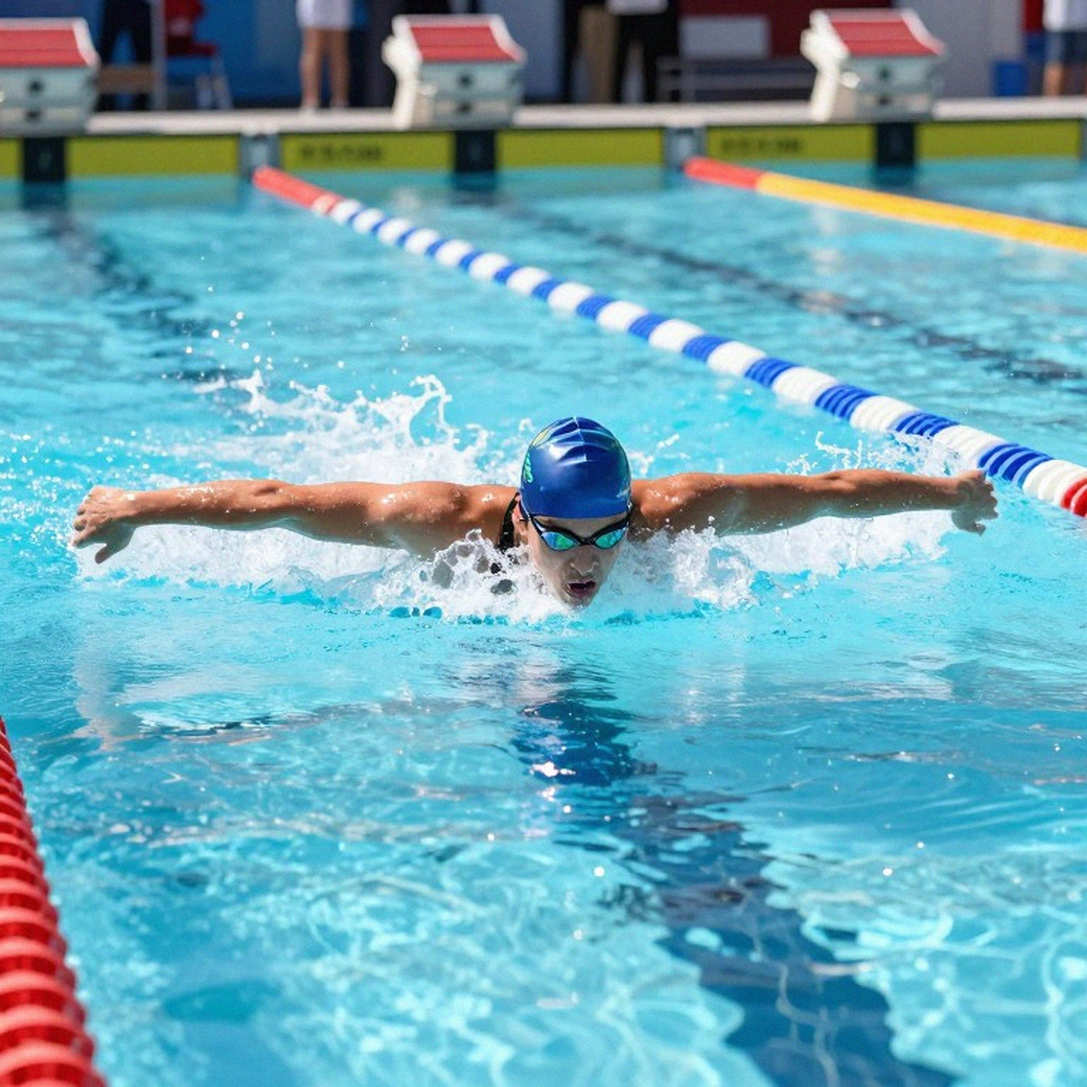
Anderson's 2026-26 season data tells a clear story. At Winter Juniors – West in December 2026, she ranked 23rd in the 100-yard breaststroke with 1:02.56 and 46th in the 200-yard with 2:19.87. By March 2026, at Sectionals, she had dropped to 2:17.70 — a significant improvement. At the UIL 6A State Championships in February 2026, she placed 6th in the 100-yard breaststroke. And at Summer Junior Nationals in August 2026, she achieved 28th in the 200-meter breaststroke (2:35.39) and 38th in the 100-meter (1:12.xx).
Interestingly, her improvement isn't limited to her specialty. She also swam the 200-yard IM in 2:07.06 — just 1.74 seconds off the American Conference A-final standard. This suggests her breaststroke skills can transfer to other strokes, a positive signal for college versatility.
But let's pause for a moment. When I look at this data table, I notice something the original article doesn't mention: a 9-second improvement in the 200-yard breaststroke usually accompanies one of two factors — either a significant physical growth spurt, or a deliberate technical overhaul (e.g., narrowing kick amplitude, improving underwater body line). There's no split data in the article, so I can't determine the exact cause. But I can say this: such a large improvement in one season is rarely random.
The NCAA recruiting system Anderson is participating in is a sophisticated data-sifting machine. College coaches don't just look at times — they look at development trajectory, consistency across multiple meets, and the ability to convert between different pool configurations (short course 25 yards and long course 50 meters). Anderson has competed in at least 4 major meets in the 2026-26 season, demonstrating consistency and the ability to perform under pressure. This is a much stronger signal than a single breakout performance.
However, I want to offer a counterintuitive perspective. Many will look at the 9-second improvement and think Anderson is on track to become a star. But the data tells a different story. At Winter Juniors, she ranked 46th in the 200-yard breaststroke — but in the 200-yard IM, she was only 1.74 seconds off the American Conference A-final standard. This means the IM might actually be her hidden strength, not the breaststroke. Rice could deploy her more effectively in this position than simply viewing her as a breaststroke specialist.
Another blind spot I notice: Anderson's 9-second improvement occurred in the context of her being in the late stages of puberty. Female athletes typically peak in growth at ages 14-16, and her continued improvement at 16-17 is a positive signal — but it also means she may be approaching a stabilization phase. If she has another growth spurt, her technique may need adjustment, leading to a temporary plateau. This is something the coaches at Rice need to monitor.
Comparing with Vietnam's swimming system, I notice a fundamental difference. In the US, the club + high school + NCAA system creates a clear development pathway with multiple competition levels. In Vietnam, we're still building a similar system, but lacking connections between levels. An athlete like Anderson can compete at state meets, national junior meets, and then enter the college system — each level providing valuable data for scouts. In Vietnam, we often only have a few meets per year, and data on young athletes remains very limited.
This leads me to an important observation: Anderson's value isn't in the number 2:17.70 or 2:35.39, but in her regression line — her development trajectory across multiple seasons. An athlete who improves steadily by 2-3 seconds each year is far more valuable than one who explodes once and then plateaus. Anderson has shown consistent improvement across at least 4 major meets, and that's why Rice chose her.
But I also want to warn about a potential risk: the "post-commitment slump" syndrome. When an athlete has achieved their goal of committing to a college, training motivation can drop in their senior year. Anderson has two full development seasons before entering college competition — a long runway that could be a double-edged sword. If she maintains focus, she could improve significantly more. If not, she could plateau or worse.
Another point: verbal commitments in the NCAA are non-binding. Anderson could theoretically change her decision before signing a National Letter of Intent (NLI). This doesn't mean she will, but it's part of the mechanism. Rice, with its 2026 American Conference title, is on an upward trajectory — and having 4 commits in the class of 2031 (Anderson, Hineman, Krutiy, Yung) shows the program's growing appeal.
When I look at the big picture, I see Anderson as a solid mid-tier recruit in a deep talent pool. Texas is one of the strongest swimming states in the US, and her 6th place at the 6A state meet — the largest classification — shows she's in the top tier of the state but not number one. Her commitment to Rice, a mid-major program, accurately reflects her current competitive level.
But here's the interesting part: if I were a coach at Rice, I wouldn't slot Anderson into the breaststroke specialist position. I'd experiment with her in the 200-yard IM, where she's only 1.74 seconds off the American Conference A-final standard. With two development seasons, that gap is entirely closable. And if she can swim the 200 IM at A-final level, her value to the team increases significantly.
Numbers don't lie, but people who read numbers do. When I read the article about Anderson, I see a typical American college recruiting story — but I also see signals the article doesn't mention. The 9-second improvement could be the result of a growth spurt, a technical overhaul, or simply a good taper for Sectionals. Without split data, I can't determine exactly. But I can say this: she's an athlete worth watching, not because of her current times, but because of her development trajectory.
A miracle is just an unregressed data point. Anderson isn't a miracle — she's a young athlete developing on track within a system designed to optimize that development. The real question isn't whether she can repeat the 9-second improvement, but whether Rice can properly tap her potential. And that's a question only time — and data from the next two seasons — can answer.
When the world stops spinning, I create my own data rotation. And in that rotation, I see Anderson standing at a favorable position: post-puberty, with a positive improvement trajectory, and two development seasons before college competition. This is the golden window in a young athlete's career. The question is whether she and the coaching staff at Rice can capitalize on this window.
I don't believe in luck, I believe in margin of error. And Anderson's margin of error is narrowing — in a positive direction. But in swimming, as in life, things can change quickly. A knee injury (a characteristic risk of breaststroke), a plateau phase, or a commitment change — all are possible. The only thing we can do is follow the data, ask questions, and never stop seeking the truth behind the numbers.
Data only dies when we stop asking questions. And I still have many questions about Ashlyn Anderson. But that's what makes my job interesting.

Cầu thủ liên quan
Bài đề xuất
Ashlyn Anderson and the 9-Second Drop: Miracle or Regression Line of a Young Record-Breaker?2026-09-04
Jane Kavanagh Commits to Notre Dame: Future Prospects or Challenges in NCAA Swimming2026-09-06
Mehdy Metella: 28 Years Swimming with the Current, and the Moment He Stepped Ashore2026-09-04
Gui Caribe swims 50m freestyle in 20.54 and Leonardo Alcântara breaks South American record in 800m with 7:37.47 at Jose Finkel Trophy2026-09-06
Mehdy Metella Announces Retirement: A Thank You After 28 Years of Swimming2026-09-04
From Rainy My Dinh to the Southeast Asian Throne: Decoding Vietnam Football's Silent Revolution2026-09-03
Spyros Argeros commits to Columbia University: Blowing up Ivy League swimming prospects for class of 20312026-09-10
Bài đề xuất
Jane Kavanagh Commits to Notre Dame: Future Prospects or Challenges in NCAA Swimming2026-09-06
Mehdy Metella: 28 Years Swimming with the Current, and the Moment He Stepped Ashore2026-09-04
Spyros Argeros commits to Columbia University: Blowing up Ivy League swimming prospects for class of 20312026-09-10
A Pool Without Data: Lakeside Aquatic Club and the Governance Challenge of Youth Swimming Development2026-09-04
US Swimming 2026 Events: 18,701 Spectators at Irvine Aquatics Center Signals Declining Interest2026-09-08
When an Analysis Has No Data: Lessons from an Empty Swimming Document2026-09-07
A 2027 Commitment Is Not the Finish Line: Reading Jackson Kroh's Profile Through a Data Lens2026-09-06
Bài đề xuất
Volunteer Diving Coach at Bryant: A Signal from a System Tightening Costs2026-09-04
From Rainy My Dinh to the Southeast Asian Throne: Decoding Vietnam Football's Silent Revolution2026-09-03
Mehdy Metella: 28 Years Swimming with the Current, and the Moment He Stepped Ashore2026-09-04
A 2027 Commitment Is Not the Finish Line: Reading Jackson Kroh's Profile Through a Data Lens2026-09-06
Vietnamese Sunrise: Data Analysis of Nguyen Huy Hoang's Progress at 2026 Olympics2026-09-05
Jane Kavanagh Commits to Notre Dame: Future Prospects or Challenges in NCAA Swimming2026-09-06
US Swimming 2026 Events: 18,701 Spectators at Irvine Aquatics Center Signals Declining Interest2026-09-08
Bài đề xuất
Mehdy Metella Announces Retirement: A Thank You After 28 Years of Swimming2026-09-04
A Pool Without Data: Lakeside Aquatic Club and the Governance Challenge of Youth Swimming Development2026-09-04
Matsushita breaks Asian record in 400m IM: When patience becomes a dance2026-09-04
From Rainy My Dinh to the Southeast Asian Throne: Decoding Vietnam Football's Silent Revolution2026-09-03
A 2027 Commitment Is Not the Finish Line: Reading Jackson Kroh's Profile Through a Data Lens2026-09-06
Spyros Argeros commits to Columbia University: Blowing up Ivy League swimming prospects for class of 20312026-09-10